Fish Quill

fishquill

Fish Quill Poetry Boat was founded in 2010 by Canadian poets Linda Besner and Leigh Kotsilidis.

On several occasions the Fish Quill Poetry Boat came to the Elora Poetry Centre so that we were able to hear fine work from Canadian poets and  superb music by singer-songwriters–all thanks to the country’s oldest communication system: the river.

The Good Hearted Women Singers

The Good Hearted Women Singers

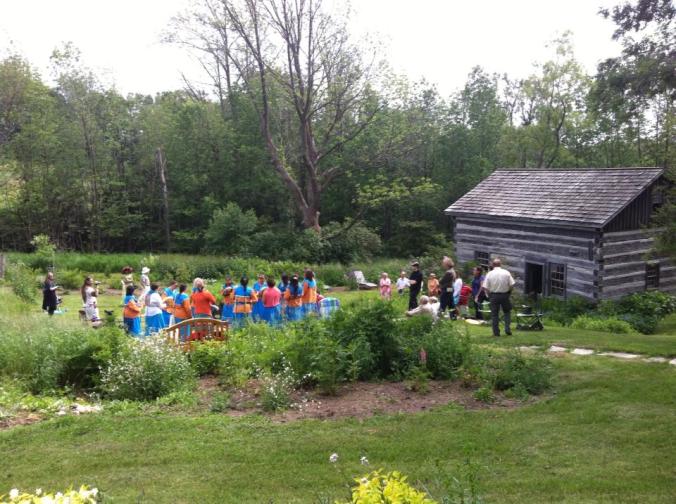
We are Indigenous and non-Indigenous women following the drum circle teachings of Community Elder Jean Becker, who began this group in 2003

We have been taught to follow the teachings of the Seven Grandfathers. These are the values of: wisdom, truth, humility, courage, honesty, respect, love.

These teachings guide us in our relationships with ourselves and each other and they help guide us towards living our lives in a balanced way.

 Our drum group reflects a sweetgrass teaching. One blade of sweetgrass by itself is not very strong. It can break easily. When several blades of sweetgrass are braided together, the sweetgrass is strong and cannot easily be broken. The singing and drumming helps us to find the strength to keep going. A woman may feel reluctant and not have the confidence to lead a song, but she gives it a try because she knows that the others will be there to pick up the song if she falters. That song will be carried on, just as we all must carry on with our lives, no matter what. Just as the braided sweetgrass is strong, our “knowing” that we have the strength and support of one another helps us to carry on.

1001168_530442026993801_718048922_n

Christopher Dewdney

Christopher Dewdney was born in London, Ontario, in 1951. His father was the renowned archeologist, author and historian Selwyn Dewdney. ” Because of my father’s concerns, I grew up with a prodigious amount of national history, natural history, and there was as much art around the house as there was science”.

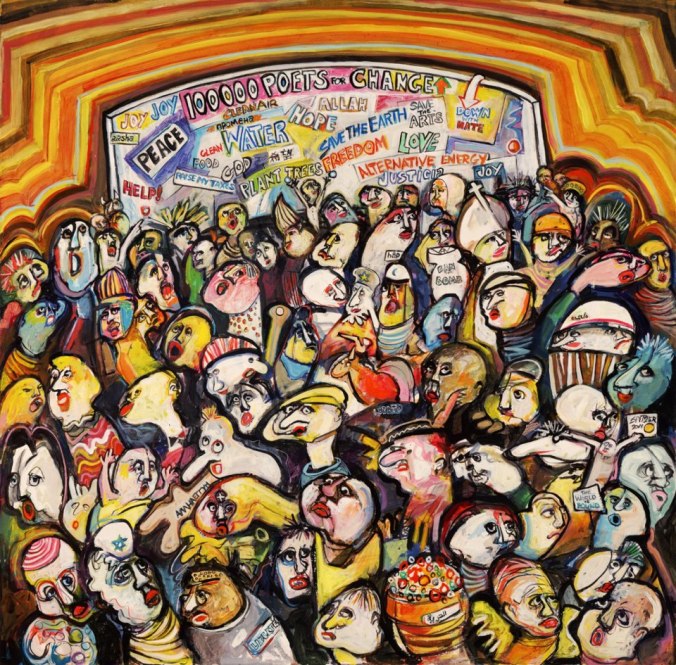
Dewdney’s reading was part of San Francisco poet, editor, and environmental activist Michael Rothenberg’s world-wide 100 Thousand Poets for Change. Over 400 events took place on that day.

Among the poems Chris read was The Elora Gorge Suite, from Radiant Inventory, which was nominated for a Governor General’s Award.

The Radiant Inventory: Christopher Dewdney: 9780771026997: Amazon.com ...

100 Thousand Poets for Change September 30 4pm

The Elora Poetry Centre & Gallery presented the annual global “100 Thousand Poets for Change” day at which poets and artists around the world celebrated peace, sustainability, and justice, and called for serious social, environmental, and political change. Canadian poet and artist, bill bissett, the “shaman of sound and performance,” read/chanted/danced his work. Among bissett’s awards are The George Woodcock Lifetime Achievement Award and the Dorothy Livesay Prize. The event was held on September 30th at 4p.m. at the Elora Poetry Centre & Gallery. There was live music, finger food, and conversation.
elorapoetrycentre@gmail.com. 519-846-2551

Cid Corman: In Collaboration

Those of you who attended Micheal Basinski’s performance here in the fall of 2015 will realise how honoured we feel that The Poetry Collection, Capen Hall, University at Buffalo, has mounted a sizable part of our Cid Corman collection, which will remain open until 18 January 2017.  For those who have not visited the Poetry Collection, and who have time to spend a day in Buffalo,  below are a few extracts from the Collection’s website. If considering a day trip, the Knox-Albright gallery is not far away.

The Poetry Collection is only twenty minutes from the border if you take the Lewiston Bridge.  Please contact us if you want guidance for a simple route.

Poetry Collections

Poetry Publications

When the Poetry Collection began in 1937, its original mission was to collect first editions of poetry written in English and English translation published since 1900. Today, the collection houses over 140,000 titles of Anglophone poetry including 6,600 broadsides as well as an extensive selection of little magazines, anthologies, criticism, reference books, ephemera and audio recordings, making it the largest poetry library of its kind in North America.

Little Magazines

Throughout the 20th century, “little magazines”—magazines usually noncommercial in nature and often committed to certain literary ideals—have been a primary organ for the dissemination of poetry and for the formation of literary communities across the aesthetic and political spectra.

The Poetry Collection maintains a comprehensive selection of over 9,000 titles of past and current little magazines, literary journals, university reviews, newspapers and other poetry periodicals, and is particularly strong in its holdings of independent publications.

Literary Archives

Soon after establishing the Poetry Collection, Charles Abbott made a concerted effort to begin collecting the working manuscripts and letters of contemporary poets, soliciting donations from hundreds of writers such as Ezra Pound, Marianne Moore and Wallace Stevens and establishing a tradition of acquiring others. These form the foundation of the Contemporary Manuscripts Collection, which contains tens of thousands of pages of manuscripts and correspondence from hundreds of American, British, Irish, Canadian and Australian authors. Additionally, there are more than 150 named collections, including the world’s largest and most distinguished archive of James Joyce manuscripts as well as major selections of papers from Robert Graves, Theodore Enslin, Robert Duncan, John Logan, Helen Adam, John Montague, Clark Coolidge, Michael Palmer, William Carlos Williams, Basil Bunting, Dylan Thomas, Jonathan Williams and Wyndham Lewis. The collection also holds the archives of several important small presses and magazines.

Also featured in the Poetry Collection are the personal libraries of writers such as Helen Adam, Basil Bunting, Robert Duncan, James Joyce and John Logan; artworks by Constantin Brancusi, Jess (Collins), Wyndham Lewis, E. E. Cummings and many others; and substantial collections of mail art, visual and concrete poetry, photographs and zines.

100 Thousand Poets for Change

100 Thousand Poets for Change

24 September 2016

4.30 p.m.

This event, originally created by Michael Rothenberg “as a demonstration / celebration to promote peace, sustainability and justice . . .and to call for serious social, environmental and political change,” took place simultaneously in hundreds of sites throughout the world.

Because this was the Centre’s fourth year, we decided to ask three speakers, Greg Smith-Young, Peter Scott and Morvern McNie, to give their views in poetry and prose. After they had all spoken there was open discussion.

As the event was billed for artists as well as poets, we invited visual artists to bring with them an item which they felt was in keeping with the above context. A written explanation was to accompany each work.

During the afternoon Nick Kosonic entertained us with his Solfeggio scale steel drum and Hang/Hung drum.

Elora Poetry Centre

644248_424366357595600_247179097_n

Save

Save

Is it time to bring back the Arts Olympics?

When Asa Boxer was last here to share his new work Etymologies, he mentioned he would soon be off to Rio for the Arts Olympics.  Here is a segment on CBC Radio’s Q discussing the Arts Olympics.

“As 2016 Olympics wind down in Rio, preparations have begun for an entirely different kind of games.

Few present-day fans know that Olympic organizers used to give out medals for artistic achievement. From 1912 to 1948, artists would compete in categories such as music, painting, literature and sculpture.”

The links are below:

http://www.cbc.ca/radio/q/schedule-for-thursday-august-18-2016-1.3726060/is-it-time-to-bring-back-the-arts-olympics-1.3726076

—From Word to Word by Jeremy Luke Hill on Prager’s Echoes in the Timbers

“Jerry Prager’s Echoes in the Timbers is a prose poem that relates the death and inquest of Margaret Buckingham, a former slave who settled in Puslinch County in the mid-nineteenth century. The narrative is broken into several parts, each with a different speaker – including Margaret herself; her suitor, Jerry Collins; and a member of her inquest jury, Nicholas Beaver, whose house has since been moved to the grounds of the Elora Poetry Centre. Margaret actually visited Beaver House in her day, so it’s fitting that it was where Jerry first read Echoes in the Timbers in 2014 and where the published version was recently launched.

To read the rest of the post click the link below:

https://jeremylukehill.wordpress.com/2016/07/27/jerry-pragers-echoes-in-the-timbers/